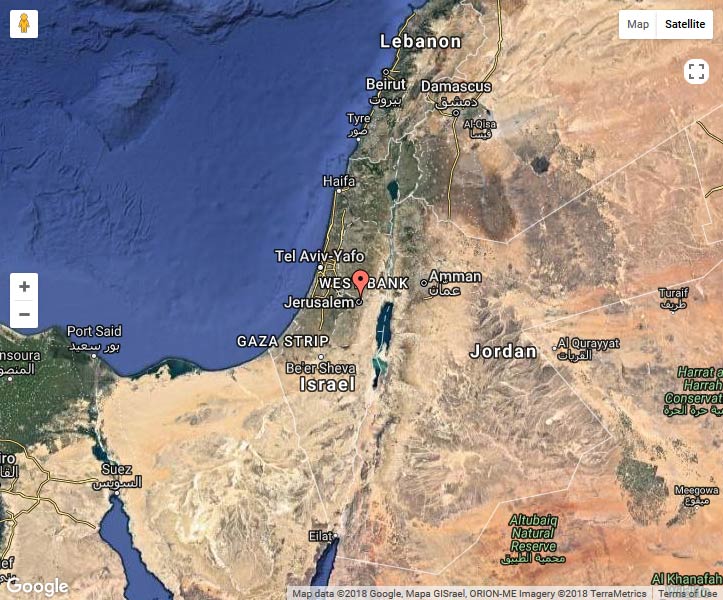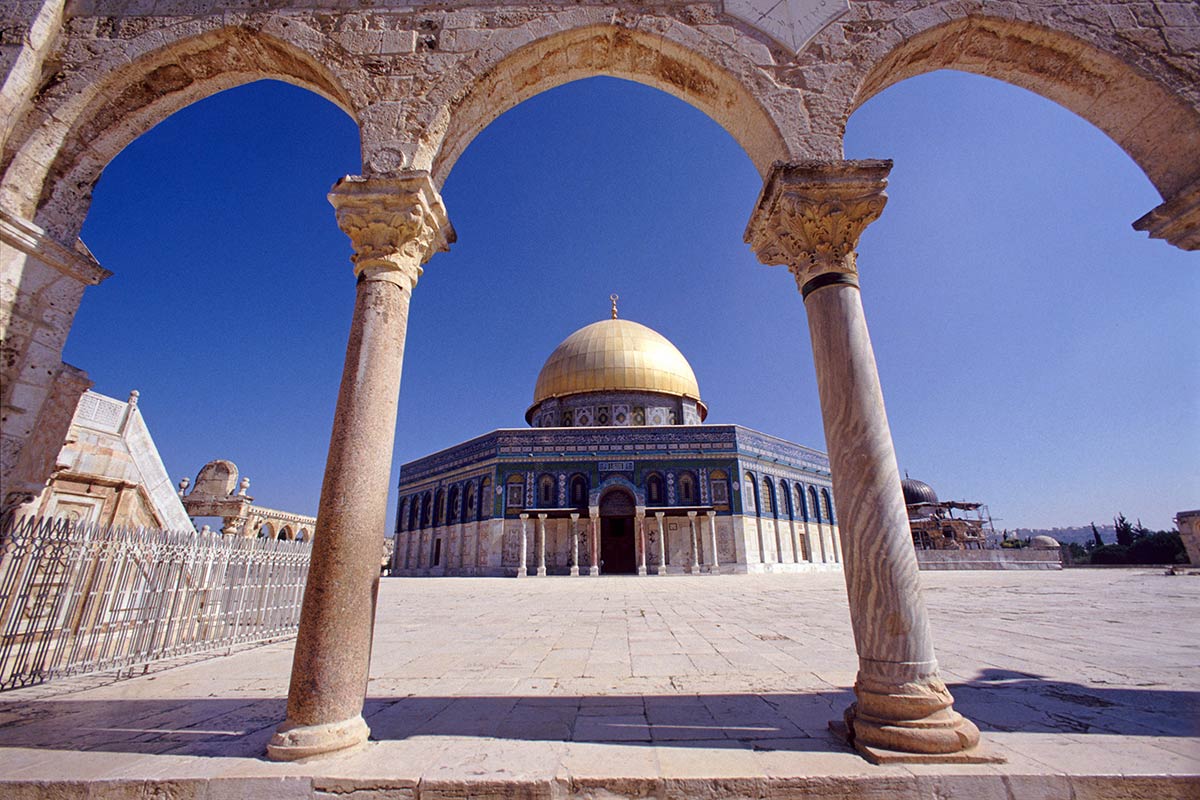
Dome of the Rock, Jerusalem, Israel (Enlarge)
Jerusalem, by virtue of the number and diversity of people who have held it sacred, may be considered the most holy city in the world. To the Jewish people it is Ir Ha-Kodesh (the Holy City), the Biblical Zion, the City of David, the site of Solomon's Temple, and the eternal capital of the Israelite nation. To Christians it is where the young Jesus impressed the sages at the Jewish Temple, where he spent the last days of his ministry, and where the Last Supper, the Crucifixion and the Resurrection took place. Also greatly venerated by the Muslims, it is where the prophet Muhammad ascended to heaven. While highly charged with intense religious devotion and visited by countless pilgrims and sages, Jerusalem has also been ravaged by thirty centuries of warfare and strife. It is a place of beauty and divinity, mystery and paradox; a sacred site which no modern spiritual seeker should fail to experience.
The earliest traces of human settlement in the Jerusalem area are from the late Chalcolithic and Early Bronze Age (3000 BC). Excavations have shown that a town existed on the south side of Mount Moriah, also called Temple Mount. The name of this town was Urusalim, a word probably of Semitic origin that apparently means 'Foundation of Shalem' or 'Foundation of God'. On the frontier of Benjamin and Judah, the town was inhabited by a mixed population known as Jebusites. About 1000 BC, Urusalim was captured by David, founder of the joint kingdom of Israel and Judah, and became the Jewish kingdom's capital. In the earlier wandering years of the Israelites, their most sacred object, the Ark of the Covenant, was periodically moved about among several sanctuaries, but following David's capture of Urusalim, the Ark was moved to that city around 955 BC. The Ark was a portable shrine containing the two stone Tablets of the Law that the prophet Moses had received upon Mt. Sinai. David renamed his city Jerusalem, meaning 'City of Peace' in Hebrew, and chose Mt. Moriah as the site of his future temple.
Mt. Moriah was already considered highly sacred for several reasons. An ancient Semitic tradition stated that the bare rock atop the mount was held in the mouth of the serpent Tahum, and that this place was the intersection of the underworld and the upper world. It was also considered to be the site where Abraham had built an altar on which he prepared to sacrifice his son Isaac. At this same site, the patriarch Jacob gathered stone from the altar upon which his father Isaac was to be sacrificed, and using this stone as a pillow spent the night sleeping upon the rock. Upon waking from a stunning visionary dream, Jacob anointed the stone pillow with oil he had received from heaven and the stone then sank deep into the earth, to become the foundation stone of the great temple that would later be built by Solomon. This hallowed site is known as Bethel, meaning "Gate or House of Heaven."
The First Temple of the Jews was built during the reign of David's son, Solomon. King David had planned to build the Temple at the exact place where he had experienced a revelatory vision of angels ascending a golden ladder into the sky. This site, the threshing floor of Ornan the Jebusite was originally sacred to the harvest deity known as Tammuz (another name for the deity Adonis). God, through Nathan the prophet, rejected David's wish, evidently on the grounds that he had shed blood, and instead informed him that the Temple would be erected by his son Solomon (II Sam.7:12-13). The Temple 's construction took seven years and was completed in 957 BC. Soon after the Temple 's construction, Nebuchadrezzar II of Babylon forced the Jews into exile, removed their temple treasures in 604 BC and 597 BC, and finally completely destroyed the temple in 586 BC. In 539 BC, Cyrus of Persia conquered Babylon and allowed the Jews to return to Jerusalem. Reconstruction began and the Second Temple was completed by 515 BC. This temple however, did not enshrine the Ark of the Covenant as that sacred object had disappeared sometime before the plundering by Nebuchadrezzar.
The date of the Arc's disappearance and its subsequent whereabouts - long a mystery to archaeologists, historians and biblical scholars - have recently been discussed by the British researcher Graham Hancock. In his richly detailed book, The Sign and the Seal, Hancock presents evidence that the Arc was removed by Jewish priests from Solomon's temple during the rule of the apostate King Manasseh (687-642 BC). The Arc was then hidden for two hundred years in a Jewish temple on the Egyptian sacred island of Elephantine in the Nile. Next it was taken to Ethiopia, to the island of Tana Kirkos in Lake Tana, where it remained for over 800 years until being brought to the city of Axum, capital of the Axumite kingdom. When that kingdom was converted to Christianity after 331 AD, the Arc of the Covenant was placed in a church of St. Mary of Zion where it remains to this day.
Writing in his book Lost Secrets of the Sacred Ark, author Laurence Gardner disagrees with Hancock's assertions, and states that the Axumite Ark "Called a manbara tabot, is actually a casket which contains a venerated altar slab known as a tabot. The reality is that, although the Axum chest might be of some particular cultural significance in the region, there are manbara tabotat (plural of tabot) in churches across the breadth of Ethiopia. The tabotat which they contain are rectangular altar slabs, made of wood or stone. Clearly, the prized manbara tabot of Axum is of considerable sacred interest and, by linguistic definition, it is indeed an ark - but it is not the biblical Ark of the Covenant, nor anything remotely like it."
Other sources researched by Laurence Gardner indicate that the Arc of the Covenant had been hidden beneath Solomon's Temple at the time of King Josiah (597 BC) so as not to be seized by Nebuchadnezzar and the Babylonians. In his Mishneh Torah of 1180, the Spanish philosopher Moses Maimondes told that Solomon had constructed a special hiding place for the Arc in tunnels deep beneath the temple. The prophet Jeremiah, son of Hilkiah who became the High Priest of Jerusalem, was the captain of Hilkiah's Temple Guard. Prior to Nebuchadnezzar's invasion, Hilkiah instructed Jeremiah to have his men secrete the Arc of the Covenant, along with other sacred treasures, in the vaults beneath the Temple. More than 1700 years later a group of nine Frenchmen known as the original Knights Templars spent the years from 1118 to 1127 excavating beneath the El-Aqsa mosque on the site of the old Temple of Jerusalem. They retrieved, in addition to a vast wealth of gold bullion and hidden treasures, the true Arc of the Covenant. While the existence and exact location of this Arc are not currently known, the Templars soon became one of the most powerful religious and political institutions in medieval Europe.
Over the next five centuries Jerusalem was captured by Alexander the Great, controlled by Hellenistic, Egyptian, and Seleucid empires as well as experiencing occasional periods of Jewish freedom. In 64 BC, the Roman general Pompey captured Jerusalem, ushering in several centuries of Roman rule. During this period Herod the Great (ruled 37-4 BC) rebuilt and enlarged the Second Temple and created the famous Western Wall (also called the Wailing Wall) as part of the supporting structure for the enlarged Temple Mount. In 6AD the Romans turned the governance of Jerusalem over to a series of administrators known as procurators, the fifth of whom, Pontius Pilate, ordered the execution of Jesus. During the next two centuries the Jews twice revolted against their Roman oppressors, the city of Jerusalem suffered greatly and the Second Temple was demolished in 70 AD. In the year 135 AD, the Roman Emperor Hadrian began construction of a new city, called Aelia Capitolina, upon the ruins of old Jerusalem. Upon the site of the destroyed Jewish temple, Hadrian built a temple to the god Jove (the Greek Jupiter), but this temple was itself demolished by the Byzantines after the empire became Christian.
The conversion to Christianity of the Byzantine Emperor Constantine (306-337) and the pilgrimage of his mother, Empress Helena, to Jerusalem in 326 inaugurated one of the city's most peaceful and prosperous epochs. According to Christian legends, Empress Helena discovered the relics of the 'True Cross of the Crucifixion' at the place of the Resurrection upon Mt. Calvary. Scholars however, believe this so-called 'finding' of the relics to be a story fabricated for political reasons by Constantine and his mother, and that the cross relics were most probably manufactured, as were so many other relics during early and medieval Christian times. Whatever the case, Helena's pilgrimage and Constantine's royal support made possible the building of many Christian shrines in the city.
Foremost among these Christian shrines was the Church of the Holy Sepulchre which marked the site of the Resurrection and which soon became the supremely sacred place in all of Christendom. Finished in 335 AD, the great basilica was apparently built upon the foundations of an earlier Roman shrine dedicated to the goddess Aphrodite. It was during this splendid era of church construction that the tradition of Christian pilgrimages to Jerusalem began. The most visited pilgrimage sites were Bethlehem, were Jesus was born; Golgatha, the site of his death (and where legend says the skull of Adam is buried); the Church of the Holy Sepulchre; and the Mount of Olives, where Jesus (supposedly) ascended to heaven. The Christian glorification of Jerusalem was carried on until 614 AD when the Persians invaded the city, massacred the inhabitants, and destroyed many of the churches and monasteries.
Dome of the Rock
Following a brief period of Persian rule, Jerusalem was captured in 638, six years after the death of Muhammad, by the Muslim Caliph Umar. Soon after his occupation of the city, Umar cleansed the Temple Mount, built a small mosque and dedicated the site to Muslim worship. The most imposing structure the Muslims found in Jerusalem was the Church of the Holy Sepulchre. Nearby the Arab conquerors undertook to build a more spectacular edifice, the Dome of the Rock, not only to proclaim the supremacy of Islam, but also to ensure that the new followers of Islam would not be tempted by Christianity. The site chosen was the very same rock where previously had stood the Jupiter temple of the Romans and before that, the two temples of the Jews.
Yet there was another reason for the Muslim veneration of this particular site, one more important than the political expediency of usurping another religion's holy place. A certain passage in the Koran links the Prophet Muhammad with Jerusalem and the Temple Mount. That passage, the seventeenth Sura, entitled 'The Night Journey', relates that Muhammad was carried by night 'from the sacred temple to the temple that is most remote, whose precinct we have blessed, that we might show him our signs...' Muslim belief identifies the two temples mentioned in this verse as being in Mecca and Jerusalem. According to tradition, Muhammad's mystic night journey was in the company of the Archangel Gabriel, and they rode on a winged steed called El Burak (meaning `lightning'), which according to Islamic Hadith tradition was a winged, horse-like creature that was "smaller than a mule, but larger than a donkey." Stopping briefly at Mt. Sinai and Bethlehem, they finally alighted at Temple Mount in Jerusalem, and there encountered Abraham, Moses, Jesus and other prophets, whom Muhammad led in prayers. Gabriel then escorted Muhammad to the pinnacle of the rock, which the Arabs call as-Sakhra, where a ladder of golden light materialized. On this glittering shaft, Muhammad ascended through the seven heavens into the presence of Allah, from whom he received instructions for himself and his followers. Following his divine meeting, Muhammad was flown back to Mecca by Gabriel and the winged horse, arriving there before dawn.
At this hallowed site, known in Arabic as Haram al Sharif, the 9th Caliph, Abd al-Malik, built the great Dome of the Rock between 687 and 691. Besides its association with the `Night Journey' of Muhammad, Jerusalem was also chosen as the site of this first great work of Islamic architecture for political reasons. For a brief period between 680 and 692 Mecca had become the capital of a rival caliphate established by Abd Allah ibn Zubayr who controlled most of Arabia and Iraq. Following the retreat of the Umayyad army from its siege of Mecca the construction of the Dome was undertaken in order to discourage pilgrimages to Mecca. Often incorrectly called the Mosque of Umar, the Dome of the Rock, known in Arabic as Qubbat As-Sakhrah, is not a mosque for public worship but rather a mashhad, a shrine for pilgrims. Adjacent to the Dome is the Al-Aqsa Mosque wherein Muslims make their prayers. Designed by Byzantine architects engaged by the Caliph, the Dome of the Rock was the greatest monumental building in early Islamic history and remains today one of the most sublime examples of artistic genius that humanity has ever produced (the Great Mosque of Damascus, being a true mosque, is the earliest surviving monumental mosque). The dome is 20 meters high, 10 meters in diameter, and its supporting structure, made of lead, was originally covered in pure gold (the real gold was removed over the centuries and the dome is now made of anodized aluminum). The sacred foundation stone is encircled by sixteen arches that formerly came from different churches in Jerusalem, which were destroyed during the Persian occupation of the city in 614 AD. Writing of the sublimely beautiful structure with its heavenly dome, its columns of rare marble and its brilliant mosaics, the British authority on Muslim architecture, K.A.C. Creswell, exclaimed:
"Under a scheme whereby the size of every part is related to every other part in some definite proportion, the building instead of being a collection of odd notes becomes a harmonious chord in stones, a sort of living crystal; and after all it really is not strange that harmonies of this sort should appeal to us through our sight, just as chords in music appeal to our hearing. Some of the ratios involved are fundamental in time and space, they go right down to the very basis of our nature, and of the physical universe in which we live and move."
The Dome of the Rock, while certainly one of the world's great architectural masterpieces, is often incorrectly understood to be an Islamic creation. Writing about the non-Islamic influences on the architectural style of the Dome, the author of Muslim Religious Architecture, Dogan Kuban, comments that,
"Art historians have kept up an unceasing flow of studies of the Dome of the Rock. In the context of Islamic architecture it remains unique, but in that of Roman architecture its form is directly in line with the late tradition in Syria. All of its important features, from the interior double colonnades to the great wooden dome, have been shown to be faithful reproductions of features of the Cathedral of Bosra in southern Syria. Its well-known mosaic decoration is Islamic only in the sense that the vocabulary is syncretic and does not include representation of men or animals. The entire building might be viewed as the last blossoming of the Hellenistic tradition before the Islamic synthesis created its own formulas."
The holy rock of Sakhrah in Jerusalem was for a few years the primary sacred site of Islam. When Muhammad had fled to Medina (the second sacred city of Islam) he told his followers to make Jerusalem the kiblah, as was the Jewish tradition. Following a quarrel with the Jews in Medina, Muhammad received a revelation from Allah (Sura 2:45) that directed him to reorient the direction of the kiblah from Jerusalem to Mecca, where it has since remained.
The Muslims in power before and during the Dome's construction period had tolerated Christianity and Judaism, allowing pilgrims of both religions to freely visit the Holy City. This era of peaceful coexistence ended in 969 however, when control of the city passed to the Fatimid caliphs of Egypt (a radical and somewhat intolerant Shiite sect) who systematically destroyed all synagogues and churches. In 1071 the Seljuk Turks defeated the Byzantines, displaced the Egyptians as masters of the Holy Land, and closed the long established pilgrimage routes. The prohibition of Christian pilgrimage by these less tolerant Muslim rulers angered Western Europe and became a contributing cause of the Crusades, a series of invasions that culminated in the capture of Jerusalem in 1099. The Christian Kingdom lasted almost 90 years, during which time the Dome of the Rock was converted to a Christian shrine and named Templum Domini (meaning Temple of the Lord), the Church of the Holy Sepulchre was rebuilt, and hospices and monasteries were founded. The city was recaptured by the Muslims again in 1187, was ruled by the Mamlukes from the 13th to 15th centuries (except for the brief periods of Christian control in 1229-1239 and 1240-1244) and the Turks until the 19th century. The Jews, who had been barred by the Christian crusaders, returned from the 13th century onward, by the middle of the 19th century nearly half the city's population was Jewish, and in 1980 Jerusalem was officially made the capital of Israel.
The entire area of the Old City of Jerusalem has been charged since antiquity with the powerful energy of holiness, devotion and spiritual love. Over more than three millennia the control of the city's primary sacred places has shifted frequently between the religions of Judaism, Christianity and Islam. It must be understood however, that the energy or presence of the sacred is not monopolized by any of these faiths but rather gives rise to each of them. And this sacred presence, besides knowing no limitations of dogma, philosophy or politics, has the wonderful quality of accumulating, or increasing in intensity, over time. The holy rock of Mt. Moriah was first a Jebusite place of worship, then the site of the Jewish Temples, next the sanctuary of the Roman god Jupiter, later capped by the Muslim's Dome of the Rock, next taken over by the Christians, and still later a Muslim shrine again. This same continuity of sacred use also occurred at the site of the Church of the Holy Sepulchre which, prior to its Christian use, was the location of a temple of Aphrodite. We may thus speak about these two sites, and the many other pilgrimage destinations in Jerusalem, as containers of the accumulated spirit of holiness. That spiritual energy has been enriched over thirty centuries, like fine wine in a wooden cask, and it radiates today throughout the city of Old Jerusalem with a magnificent power.
Besides the sites discussed above, the following places are also much visited by pilgrims in the Holy City. For the Jews, the most venerable locations are Mt Zion, the traditional site of King David's tomb, and the Western Wall, where stands the only remaining part of the original temple of King Solomon. Devout Christian pilgrims will visit the fourteen stations of the Via Dolorosa, or 'Way of Sorrows'. Walking this route, the holiest Christian thoroughfare in the world, the pilgrim symbolically relives the events of Jesus' passion. Additionally, there are the shrine of the Ascension on the summit of the Mount of Olives, the garden of Gethsemane, and Mt. Zion, the site of the Last Supper. In the Dome of the Rock, beneath the ancient sacred stone, is a cave-like crypt known as Bir el- Arweh, the Well of Souls. Here, according to ancient folklore (not Islamic), the voices of the dead may sometimes be heard along with the sounds of the rivers of paradise.
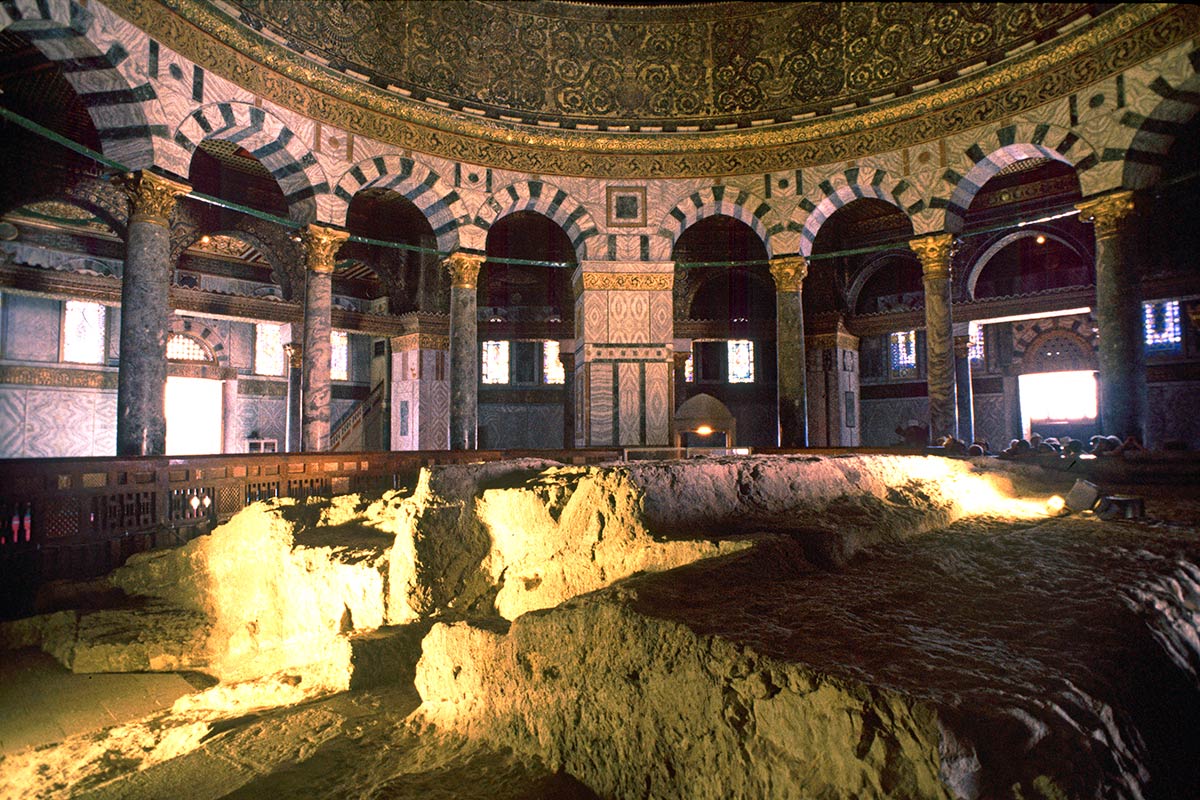
Dome of the Rock interior, City of Jerusalem, Israel (Enlarge)
Site of Herod’s temple in Jerusalem
Additional notes on Jewish pilgrimage to Jerusalem
In both the Biblical and rabbinic texts dealing with the period of the Second Temple, pilgrimage to Jerusalem is presented as a commandment incumbent on all Israelite men. Exodus 23:17, for example, states: "Three times in the year all your males shall appear before the Lord." The three times referred to in this verse are the festivals of Passover, Shavuot and Sukkot........Each festival commemorates a different part of the exodus. Thus the pilgrimages reenact, physically and spiritually, the exodus........ Although the festivals were originally tied the agricultural cycle, by the time of the editorial present of the text, they were also given historical associations. Passover was tied to the exodus from Egypt. Shavuot was associated with the giving of the commandments on Mount Sinai. Sukkot was tied to the 40 years of wandering in the wilderness. All three celebrations were thus associated to the events surrounding the acceptance of the covenant by Israel, and thus its birth as a nation apart. Mythologically and ritually the three festivals should be seen as yearly restating and reaccepting the covenantal relationship with God.
(God's Place in the World: Sacred Space and Sacred Place in Judaism, by Kunin, Seth J.)
The Holy of Holies is the most sacred place in the sanctuary, and later the Temple, which only the priest was permitted to enter. Following a pattern generally prevalent in the ancient world, the Temple structure was composed of a series of rooms or spaces within or behind other rooms, the level of holiness increasing as one progressed from front/outermost to back/innermost.
In the Temple of Jerusalem, constructed in the 10th century BCE by King Solomon, the outermost area was the vestibule (ulam). The main hall or nave (hekhal), inside, was the largest room of the building. Behind it, in the rear of the Temple building, was the Holy of Holies (devir), which measured 20 by 20 by 20 cubits.
The Arc of the Covenant and two Cherubim (winged celestial beings) were housed in this innermost room (I Kings 6:19, 23-28). These objects disappeared when the Temple was destroyed by the Babilonians in 586 BCE. Subsequent reconstruction of the building and precincts, half a century later, by those who returned from exile in Babylonia, followed the plan and measurements of Solomon's Temple. Throughout the Second Temple period the Holy of Holies was an empty room.
Only on the Day of Atonement, when he was required to atone for the sins of the entire nation, did the High Priest enter the Holy of Holies. He prepared for this moment by separating from his family a week in advance and remaining inside the Temple. He purified himself physically and spiritually and reviewed all the laws pertaining to his service. On the Day of Atonement, as part of a day of fasting, offering sacrifices, and confession of sins, the High Priest entered the Holy of Holies. He placed two hand fulls of incense on a pan of burning coals, and as the smoke filled the chamber, the Divine Presence was revealed and the nation of Israel forgiven its sins.
.....The temple was the destination of three yearly pilgrimages on the occasion of the Pilgrim festivals. Such aliyah le-regal pilgrimages took place in both biblical and Second Temple times and were a significant feature of national cultural life. During the Second Temple period, pilgrims came from the Diaspora as well as from Erets Israel. The purpose of the pilgrimage was to offer the obligatory sacrifices of the holiday. Nevertheless, pilgrimage continued even after the destruction of the Temple. Now, sacrifice was impossible and mourning was a significant part of the stay in Jerusalem. Pilgrims, upon seeing the site of the destroyed Temple, would tear their garments and recite, "Our holy Temple, our pride, where our fathers praised You, has been consumed by fire and all that was dear to us ruined." Throughout the ages, pilgrimage to Jerusalem in one form or another, never ceased entirely, although Jewish access to holy places was subject to various restrictions and harassment at different times. Since the halakhah (the branch of rabbinic literature which deals with the religious obligations of members of the Jewish faith) did not permit entry to the actual Temple site, the section known today as the Western Wall, north of the western retaining wall of the Temple Mount constructed during the time of Herod, eventually became the focus of pilgrimage and worship in Jerusalem (the term Wailing Wall was given by non-Jews to the Western Wall when they saw how the Jews who came there wept).
....The three pilgrimage festivals which the Israelites were commanded to celebrate "in the place the Lord your God will choose" (Deut. 16:16) are Passover (seven days in the Land of Israel beginning on 15 Nisan), Shavu'ot (one day in Israel, 6 Sivan), and Sukkot (eight days including Shemini Atseret, beginning on 15 Tishri). The festivals are referred to in Hebrew as the shalosh regalim, the three (foot) pilgrimages, the name being derived from the biblical ordination that all adult (i.e., age 13 or older) males go to the place God would choose, which was eventually Jerusalem.....All three festivals have both agricultural and national significance. Passover is the "festival of spring," in which a measure of the new barley crop (the Omer) is brought, and it also celebrates the Exodus from Egypt. Shavu'ot is the "harvest festival" celebrating the end of the barley harvest and the beginning of the wheat harvest, as well as the giving of the Torah at Mount Sinai. Sukkot is "the festival of the ingathering" of crops, and it also commemorates the 40 years the Israelites wandered in the desert.
....The Aramaic word, Hillula, meaning "festivity," was originally used to designate a marriage party. Among Jews in Muslim lands, the hillula generally commemorates the death of a sage, whose soul is regarded as having been reunited with its Creator. The classic instance of the hillula is that marking the traditional anniversary of the death of Rabbi Simon Bar Yohai on Lag ba-Omer, which is celebrated at his putative burial place and that of his son Eleazar in Meron, in northern Israel. Crowds as large as 100,000 people attend the festivities and large bon fires are lit and burn throughout the night. Another hillula is that of Meir Ba'al Ha-nes, on 14 Iyyar (Pesah Sheni; Second Passover) in Tiberias. In recent years the grave of Israel Abu-Hatsira ("Babi Sali") in Netivot has become the site of a pilgrimage by the Jews of North African origin on the anniversary of his death, on 3 Shevat. Other pilgrimage sites include the Cave of Machpelah, a large Herodian structure located at Hebron, believed to house the burial cave of Abraham (Gen. 23) and in which, by tradition, are buried Abraham, Isaac, and Jacob as well as their wives (except Rachel); Rachel's tomb in Jerusalem; the tomb of David on Mount Zion; the grave-sites of prophets Samuel and Zechariah in Jerusalem; and scholars and saints such as Isaac Luria in Safed and Maimonides in Tiberias.
.... Outside Israel, one of the largest hillulot is the Lag ba-Omer celebration in the courtyard of the El-Ghriba synagogue in Djerba, Tunisia. Hamadan in Persia is the site of the traditional graves of Esther and Mordecai of the Purim narrative, and the Jews of Babylonia revered the grave of Ezra located at Shatt-el-Arab, near the confluence of the Tigris and Euphrates. In Muslim lands, the tombs of revered rabbis became the objects of pilgrimage and even celebration on the death anniversary......The custom of visiting graves seems to have been introduced under Muslim influence.
(The Encyclopedia of Judaism by Wigoder, Geoffrey)
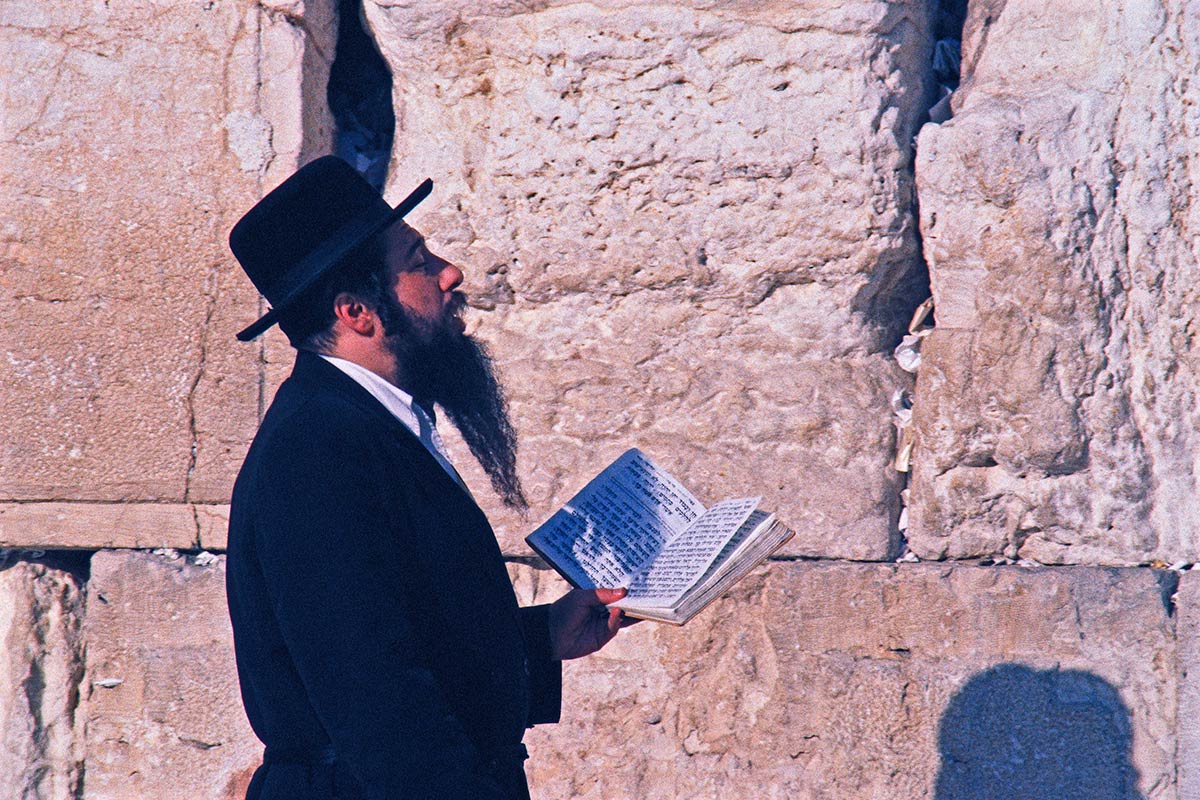
Hasidic Jew praying at the Western Wall in Jerusalem (Enlarge)
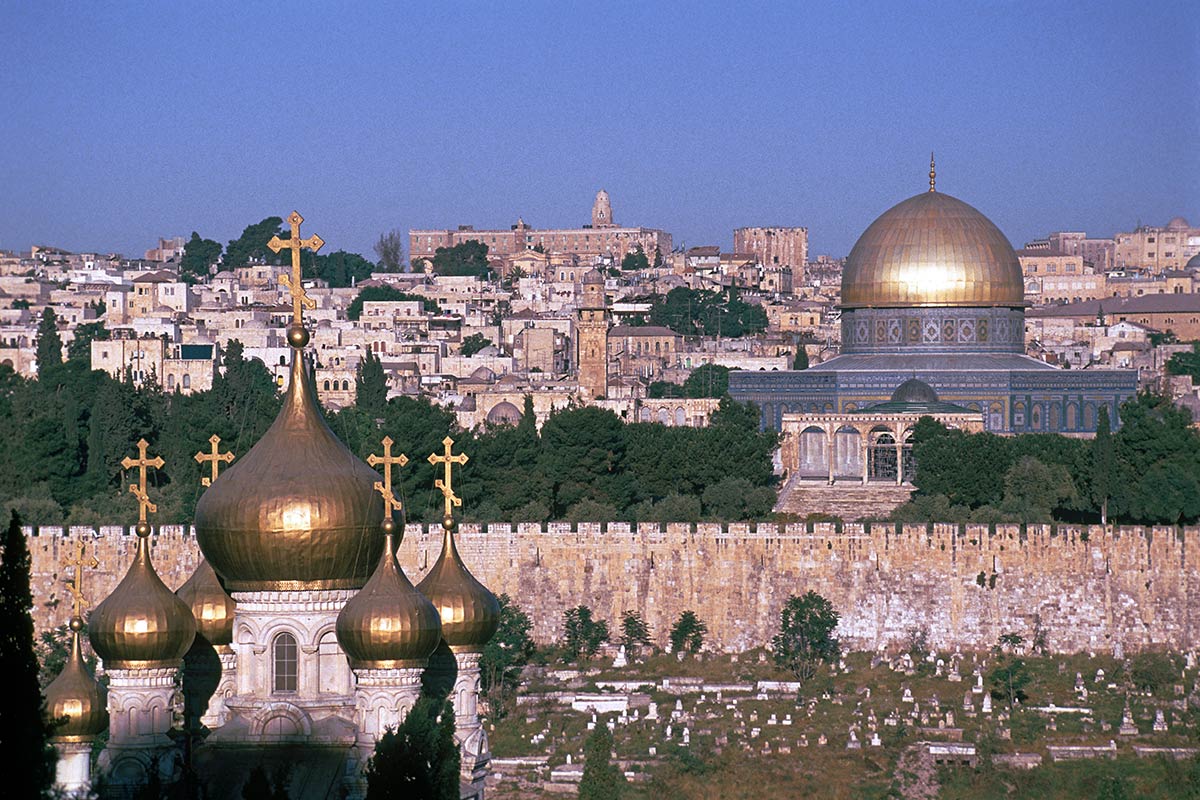
Jerusalem Panorama (Enlarge)
 Martin Gray is a cultural anthropologist, writer and photographer specializing in the study of pilgrimage traditions and sacred sites around the world. During a 40 year period he has visited more than 2000 pilgrimage places in 165 countries. The World Pilgrimage Guide at sacredsites.com is the most comprehensive source of information on this subject.
Further Reading:
Graves as attractions: Pilgrimage-tourism to Jewish holy graves in Israel
Pilgrimage Holy Sites: A Classification of Jewish Holy Sites in Israel
Additional information on Jerusalem at ancient-wisdom.